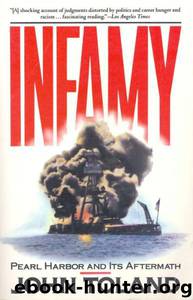
Infamy: Pearl Harbor and Its Aftermath by John Toland
Author:John Toland [Toland, John]
Language: eng
Format: epub
Tags: Asia, History, Japan, Military, Nonfiction, Retail, WWII
ISBN: 9781101872840
Google: 1jBkAwAAQBAJ
Barnesnoble:
Publisher: Knopf Doubleday Publishing Group
Published: 2014-09-23T04:00:00+00:00
* * *
1This important document was buried among exhibits on pages 2882–883 of Vol. 18, Joint Committee Hearings. See Notes.
Chapter Eleven
* * *
SAFFORD AT BAY
FEBRUARY 1–11, 1946
1.
The public interest in Safford, Kramer and the “winds” execute had been whetted since the previous November when Representative Keefe had charged he had proof that a Navy intelligence officer was being “badgered” to change his testimony about the “winds” message. The officer was Captain Kramer and he was being held in the neuropsychiatry ward of the Bethesda Naval Hospital. “He entered the Naval Hospital under orders,” Keefe told the Associated Press. “They took away his uniform and gave him pajamas, bathrobe and slippers.” He was convinced that Kramer, with whom he had had three conversations, was chafing under this restraint.
But Kramer had denied that he was being held incommunicado. “I have been a patient at the hospital for some weeks and as for being beset and beleaguered as the newspapers said, I’m feeling very well. My treatment by the Navy has been as fair and considerate as it could possibly be.” He said he could leave the hospital at his discretion and was ready to testify at the congressional hearings whenever he was called.
Richardson had been well briefed by his predecessor on the “winds” execute. In a memorandum Mitchell had stated that, although previous testimony and available information left the issue in doubt, he felt it was an unimportant issue. “Our whole reaction to the whole ‘winds’ code episode was, and still is, that it is all much ado about nothing, because even if such a signal was sent out in a broadcast by the Japs and [had] been received by the War and Navy Departments, it would have added nothing to what our people already knew.” While hoping the whole matter would be dropped, Mitchell wrote that he was aware that the sensational publicity already surrounding the issue made it necessary to continue the search for evidence.
This remained the attitude of the Democrats, who not only ridiculed the significance of the “winds” execute but were convinced it had never existed. The Republicans, as well as some neutral observers, contended that Safford’s evidence could not be treated so cavalierly and that the existence of the message proved that Washington had sufficient warning of the Pearl Harbor attack to have repulsed it.
Perhaps the person most interested in the matter, except for Safford himself, was Chief Warrant Officer Ralph T. Briggs, for he clearly recalled receiving the “winds” execute in early December 1941. At that time he was one of the qualified operators assigned to monitor all Japanese intercepts at the Navy’s East Coast intercept installation, Station M. A katakana (the Roman style of the Japanese alphabet) instructor, he was the only one on duty at Station M that night who understood the significance of “Higashi no kaze ame,” which meant “East wind, rain.”
Briggs had come to Washington just as the congressional hearings were about to begin. He was assigned to Safford’s former command, the
Download
This site does not store any files on its server. We only index and link to content provided by other sites. Please contact the content providers to delete copyright contents if any and email us, we'll remove relevant links or contents immediately.
| Africa | Americas |
| Arctic & Antarctica | Asia |
| Australia & Oceania | Europe |
| Middle East | Russia |
| United States | World |
| Ancient Civilizations | Military |
| Historical Study & Educational Resources |
The Radium Girls by Kate Moore(12042)
100 Deadly Skills by Clint Emerson(4936)
Rise and Kill First by Ronen Bergman(4803)
The Templars by Dan Jones(4698)
The Doomsday Machine by Daniel Ellsberg(4495)
The Rape of Nanking by Iris Chang(4228)
Killing England by Bill O'Reilly(4013)
Stalin by Stephen Kotkin(3974)
Hitler in Los Angeles by Steven J. Ross(3951)
12 Strong by Doug Stanton(3559)
Hitler's Monsters by Eric Kurlander(3355)
Blood and Sand by Alex Von Tunzelmann(3209)
The Code Book by Simon Singh(3203)
Darkest Hour by Anthony McCarten(3138)
The Art of War Visualized by Jessica Hagy(3015)
Hitler's Flying Saucers: A Guide to German Flying Discs of the Second World War by Stevens Henry(2761)
Babylon's Ark by Lawrence Anthony(2687)
The Second World Wars by Victor Davis Hanson(2531)
Tobruk by Peter Fitzsimons(2525)
